How to study effectively with artificial intelligence
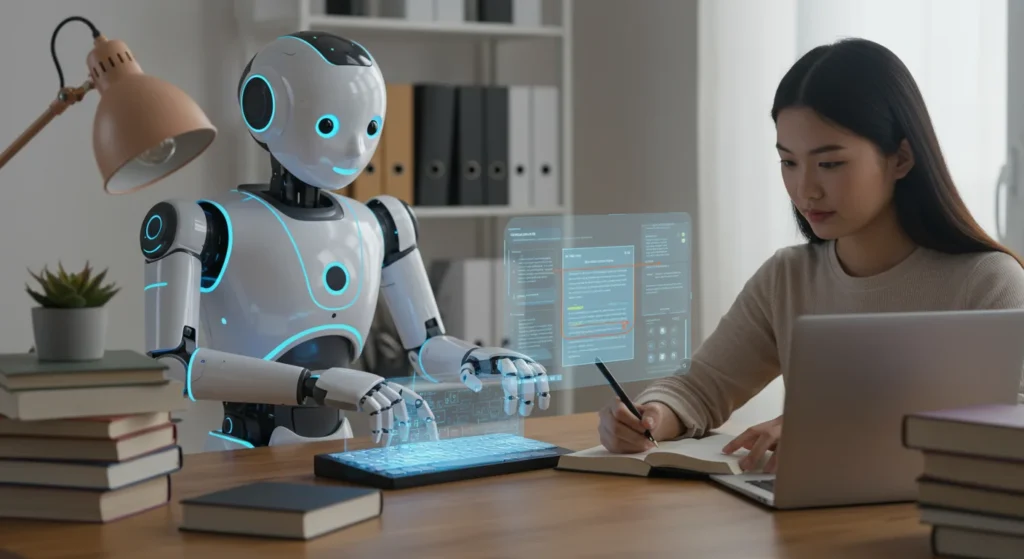
Artificial intelligence ( AI) is increasingly becoming a part of students’ daily lives, especially when it comes to effective study. It offers practical solutions for better organizing your study sessions, understanding complex concepts, and saving valuable time. As a virtual assistant, AI adapts to your needs and provides personalized tools based on your learning style.
Rather than replacing traditional methods, it intelligently complements them. It structures your revision, automates repetitive tasks, and makes learning more interactive. Used judiciously, it becomes a real lever for improving your results while developing your autonomy.
Globally, over 92% of students already use generative AI tools in their studies, and nearly 18% incorporate generated content into their assignments. In Switzerland, the trend is even stronger: institutions like EPFL and ETH Zurich are investing heavily in AI research, and many students are using it to create revision notes, simulate exams, or better understand difficult concepts. This rapid adoption clearly demonstrates that AI is gradually becoming an essential educational partner.
But then, why use it, and how can we get the most out of it?
Why use artificial intelligence for studying?
Effective revision isn’t just about rereading your notes; it’s about understanding, memorizing, and applying what you learn. That’s where AI makes a difference. It offers content tailored to your level, identifies your weaknesses, and suggests targeted exercises. In other words, it acts as an intelligent study assistant that guides you throughout your learning journey, adapting its advice to your progress.
Students mainly use it for:
-
better understanding of complex concepts (88%),
-
generate ideas (70%),
-
to conduct research (55%).
In Switzerland, 71% of young people report using AI to prepare for school or university: revision sheets, exam simulations, presentations, and more. The formats offered are varied (quizzes, diagrams, visual explanations) and make your revision much less monotonous. In short, if you’re looking to move beyond traditional methods and make your revision more active, this algorithm can truly become a valuable ally.
Using AI as a personal tutor
Imagine having a teacher available 24/7 to answer your questions or clarify a point in the lesson. That’s exactly what AI-powered assistants, accessible on computers or mobile devices, make possible.
AI acts as an engine for understanding and explanation. It analyzes your question, identifies key concepts, and then generates an answer tailored to your level. It can rephrase a definition, illustrate a concept with concrete examples, or suggest analogies to facilitate your understanding. Thanks to speech recognition and text synthesis, the interaction becomes natural and intuitive.
Organize a revision schedule using the Pomodoro Technique
A good study plan is essential to avoid stress and optimize your revision. AI can create a personalized schedule based on subjects, objectives, and pace. It incorporates techniques like the Pomodoro Technique, which alternates periods of intense concentration with short breaks to maintain efficiency.
You indicate your availability and deadlines. The AI divides the material into 25-minute work blocks followed by 5-minute breaks (Pomodoro method). It adjusts the schedule if you fall behind and can even remind you to take a break when you’re too focused.
Optimize revision notes
Flashcards remain a classic revision tool, but preparing them can be time-consuming. With AI, you can automate this process.
The tool analyzes your documents (PDFs, handwritten notes, web pages) and extracts key elements: definitions, dates, formulas, and concepts. It then organizes the information into digital index cards, mind maps, or comparison charts. You choose the format that best suits your needs for effective memorization.
Create an interactive multiple-choice quiz
To test your knowledge and boost your memory, nothing beats well-designed quizzes. Artificial intelligence can generate personalized multiple-choice questions or flashcards from your course material, adapting to your level and progress. Whether you use iPa or another tablet t, these tools become invaluable allies for dynamic and targeted revision.
Using a document or revision sheet, the AI identifies key concepts and creates a variety of questions: multiple choice, true/false, open-ended, and flashcards. It adjusts the difficulty based on your previous answers and provides immediate feedback. If you make a mistake, it explains why the answer is incorrect and rephrases the concept to help you understand it better.
Imagine reviewing biology on your Google Pixel tablet AI. Offers a quiz on cells, with progressive questions and clear explanations at each step. You can track your results, review areas of weakness, and reinforce your learning, all within an intuitive, mobile-friendly interface.
Facilitating the research process for your thesis
If you’re preparing a thesis, you know how time-consuming the research can be. AI helps you save time.
AI begins by analyzing the proposed topic and suggests approaches or issues related to academic trends. It explores databases, scientific articles, and online resources to identify the most relevant documents.
Thanks to tools like OCR (Optical Character Recognition), it can also digitize handwritten notes or photocopies of lectures, transform them into usable text, and automatically classify them. Finally, it generates bibliographies that conform to style guides (APA, MLA, and Chicago) and offers structured writing outlines.
Improve your written work.
Writing an essay or thesis requires rigor, a strong command of language, and the ability to structure ideas clearly. Thanks to artificial intelligence, you can benefit from a true writing assistant, accessible from the draft stage. By using a Copilot+ laptop, you interact seamlessly with the AI, whether to correct, rewrite, or enrich your text.
AI helps you spot grammatical errors, rephrase overly long or awkward sentences, and improve the fluency of your writing. It can also suggest synonyms, check the coherence of your ideas, and guide you in structuring your outline. The goal isn’t to completely delegate the writing process, but to leverage AI to refine your style and enhance the quality of your writing.
Learning a foreign language
Whether it’s German, English, or Italian, learning a language requires consistency, practice, and tools tailored to your level. Thanks to advances in artificial intelligence, it’s now possible to benefit from personalized support, accessible anytime, directly from an AI-powered smartphone . These tools transform learning into an interactive, dynamic, and motivating experience.
AI can generate illustrated vocabulary flashcards, offer grammar exercises tailored to your progress, and even simulate dialogues to help you practice speaking. Thanks to speech recognition, it analyzes your pronunciation and corrects you in real time. It can also instantly translate sentences, explain grammar rules, and adjust content based on your mistakes. By using an AI-powered smartphone, such as the Samsung Galaxy S25 —or, if you’re Team Apple, the iPhone 16 —you have access to these features wherever you are, whether you’re commuting, at home, or between classes.
Manage your stress and stay motivated!
The exam or assignment deadline period can be particularly stressful. To help you navigate these times more effectively, artificial intelligence offers a personalized approach to student well-being. It can incorporate relaxation routines, remind you to take regular breaks, and send you encouragement tailored to your work pace.
Among the tools offered, you’ll find breathing exercises, guided meditation techniques, and suggestions for active breaks to relieve stress. The AI can also detect signs of fatigue and adjust your schedule accordingly. It doesn’t replace a personal approach to stress management, but it can be a valuable support in establishing healthy and regular habits.
If you tend to overwork yourself, this tool can remind you to step back, breathe deeply, or even take a few minutes to meditate before resuming your studies. These small actions, integrated into your daily routine, can make a real difference to your concentration, motivation, and self-confidence.
Mistakes to avoid
Using artificial intelligence for studying is smart… as long as you don’t fall into certain traps! AI can indeed help you speed up information retrieval, clarify concepts that seem complex, or help you find a structure and a relevant plan for your ththesisbut it doesn’t replace your critical thinking or personal involvement. To get the most out of it, it’s essential to know its limitations and adopt good practices.
1- Always check the information provided
Artificial intelligence can provide you with well-formulated answers, but it’s not infallible. It can oversimplify concepts, rely on incomplete data, or even make mistakes. To avoid errors, remember to cross-reference the information with your notes, textbooks, or reliable sources. AI is there to guide you, but it’s up to you to validate its suggestions.
2- Maintain your critical thinking
AI is there to help you, not to think for you. It can structure an idea or rephrase a sentence, but your own thinking remains essential. When you use its suggestions, take the time to question them, rephrase them in your own words, and integrate them into your reasoning. This is how you will develop your intellectual autonomy.
3- Do not rely solely on digital and generated formats
AI-generated flashcards, quizzes, and summaries are useful, but they aren’t enough on their own. To truly understand, it’s important to alternate formats: write it down, explain it aloud, and draw diagrams. AI can help you structure these materials, but your personal involvement remains essential.
4- Avoid delegating the entire writing process to AI
Entrusting the complete writing of an assignment to AI may seem tempting, but it deprives you of a genuine exercise in reflection and writing. The generated text may lack nuance or coherence. You can certainly use it to help you structure your ideas, enrich your vocabulary, or correct your mistakes, but always retain control over your content. Your work should reflect your own thinking, not that of an algorithm.
To conclude
While artificial intelligence has become an essential tool, even a true ally for students, it not only saves time but also offers opportunities to optimize revision and simplify complex concepts. If used with a critical eye, it won’t replace effort, but it will complement your more traditional revision methods, adding structure, interaction, and pedagogy, and above all, personalization. Each student has their own method, skills, and learning abilities, and AI helps to tailor the experience to individual needs.
Post Comment